
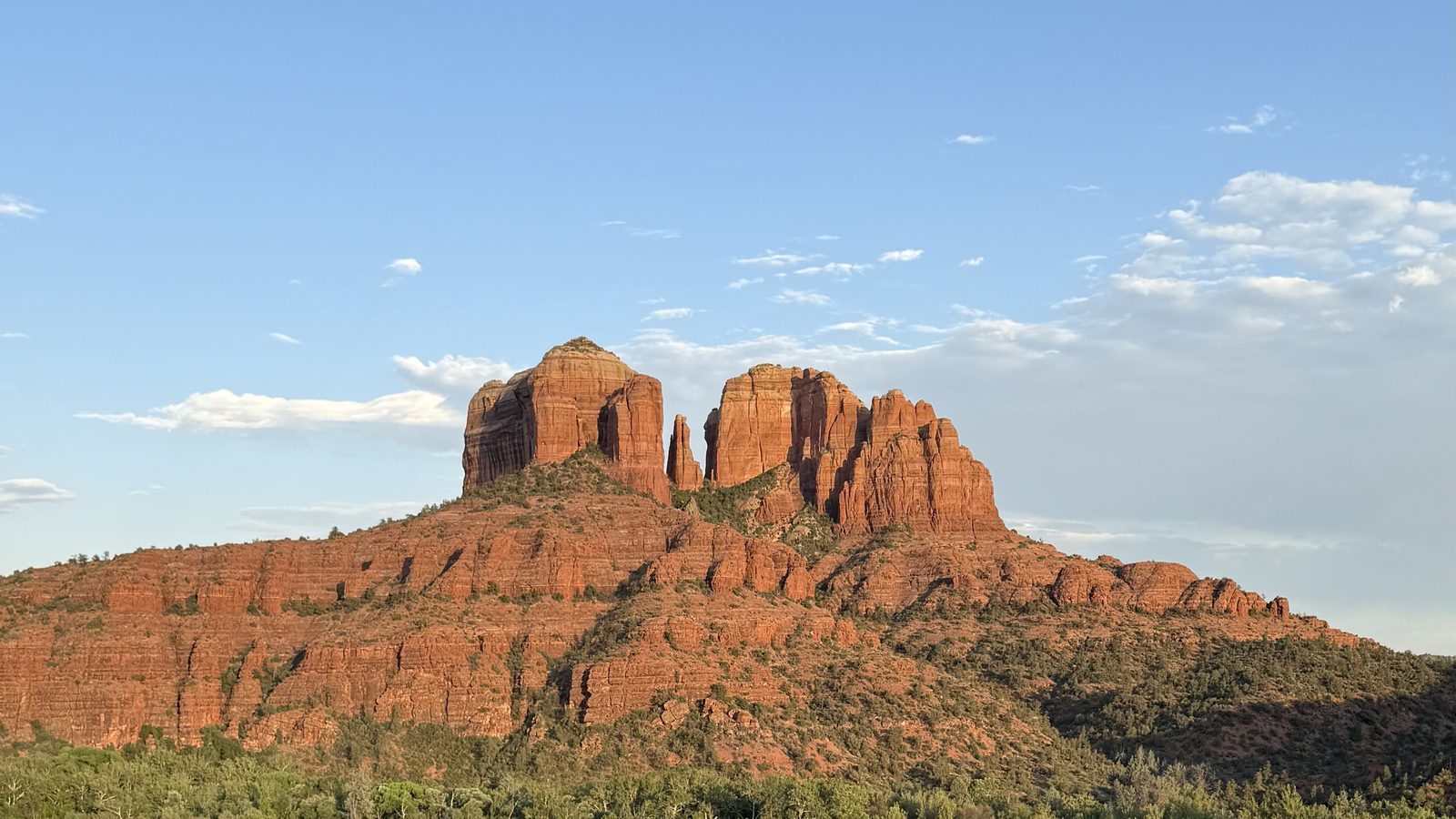
An ethic isn't a rule or a policy. It's character: the way a people live when no one is making them, shown in thousands of small daily choices.
Character becomes brand. Not who we say we are, but who people experience us to be: on the trail, at the counter, in the gallery, in traffic on 89A. You can't market your way to a reputation. You behave your way there.
So the Sedona Ethic isn't a slogan, and it isn't written yet. It's the “who we are” that Sedona's brand grows out of. This conversation exists to find it, through our past, our present, and who we become, and to write what we find, together, into a living document.
I'm a private citizen with a stake in this place and a point of view. My point of view is that Sedona only works when it works for all of it: the land itself, the residents, the workforce, the businesses, the visitors, and the civil servants who serve them. No one comes first. All of us together.
This is a privately led conversation. It isn't run by the City of Sedona or the Greater Sedona Chamber of Commerce. It doesn't speak for either of them, and it isn't bound by their positions. I serve on the City's Tourism Advisory Board and the Chamber's board of directors. This conversation is separate from both, and I hold it as a private citizen. Anyone from those rooms is welcome in this one, as one voice among many.
Privately led also means it isn't a free-for-all. It's open to everyone who will be civil and to no one who won't. Every voice gets a hearing. Not every behavior gets a stage.
The aim is alignment, not a verdict. Residents, workers, business owners, visitors, and the people who serve them each live a different Sedona. This is where those views meet, get tested, and find what they share. I don't decide who Sedona is. Neither does any office or board. We find it together, and the people who experience Sedona will tell us if we got it right.
Every day, choices get made about Sedona's future: by councils and boards, by businesses, by neighbors. They get made better when we share a picture of who we are. Clarity starts with honoring what each of us needs at the foundation:
A healthy ecology doesn't rank its parts. Each one depends on the others. Where agreement almost always fails, alignment can still win. Each part aligns with the others for the greater good.
Post under your real first and last name. Your email is confirmed once and never shown.
Your email is confirmed once with a one-tap link, and this device stays signed in. On a new device, we email you another link. Nothing to remember.
Your first comment waits until I've read it. After that, you post freely.
Propose a topic in any act. When three or more people raise the same subject, it becomes its own topic.
Every comment has a Report link, seen only by people signed in. It comes to us quietly. Nothing is hidden by a count of reports. Every report is weighed against the standard below.
Nothing enters the living document until it's researched and supported. Every point links back to the conversation it came from.
We remove comments that are hateful, demeaning, aimed at a person rather than an idea, or threatening. Strong disagreement is welcome here. Civility is the only price of admission.
Before we can say who Sedona is, we have to agree on who it has been. Here is a starting point, not the whole story.
People lived along Oak Creek for centuries before any town: the Sinagua, whom the Hopi count among their ancestors and whose places the Hopi still honor, then the Yavapai and the Dilzhe'e Apache. In 1875 the Yavapai and Dilzhe'e were forced from this valley and marched to the San Carlos reservation. Many died on the way. Years later, some walked back. Then came homesteaders, orchards, ranches, a post office named for Sedona Schnebly, Western films, an artists' colony, seekers, and a city incorporated in 1988.
What's missing? Whose story isn't told yet? What from our past should shape what we do next?
Sedona's assets and liabilities, as they seem to be now. Every ledger has two columns.
What belongs in Sedona's asset column? What belongs in its liability column? Bring your evidence.
What Sedona has that we should protect or build on.
What's costing Sedona, now or down the road.
Topics come from you. When three or more people raise the same subject, it becomes its own topic here.
The past is the record. The present is the ledger. This is the choice.
Who will we be, starting today and through the next 50 years? What will people experience when they live, work, or visit Sedona?
Topics come from you. When three or more people raise the same subject, it becomes its own topic here.
What the conversation finds, written down. Each act and its topics, synthesized once the voices have settled and the research holds. Released in editions, each with a note on what changed and why. Earlier editions stay readable.
Nothing here yet. The first edition is written when the first topics are ready, not before.
Every comment is read in full. I use AI to help organize the conversation and check the research; every line of the living document is reviewed and signed by me.